
Concrete step replacement requires controlled demolition, structural rebuilding, and code compliant finishing to ensure safety and long term stability. Steps must support repeated foot traffic, resist freeze thaw stress, and maintain uniform geometry. Athens Concrete approaches step replacement as a structural element rather than only a surface repair.
Demolition and Base Preparation
Old steps are removed to stable material. Loose fill, frost damaged concrete, and organic material must be excavated. A compacted granular base supports the new structure and reduces settling. Poor base preparation leads to differential movement, cracking, and uneven risers.
Proper drainage around the step base prevents water accumulation and frost heave.
Formwork and Layout
Forms control final dimensions, alignment, and surface finish. Accurate layout ensures consistent rise and run dimensions, which are essential for safety. Irregular riser heights increase trip risk. Forms must be braced to prevent movement during placement.
Reinforcement and Structural Integrity
Reinforcement is installed to improve tensile capacity and control cracking. Steel placement is positioned within the slab thickness to resist bending forces from foot traffic and soil movement. Reinforcement ties steps together as one unit rather than independent pieces.
Riser Height, Tread Depth, and Nosing
Step geometry must follow code compliant proportions. Riser heights should be uniform across all steps. Tread depth must allow full foot placement. Nosing, the front edge of the tread, provides additional surface area and visual definition. Rounded or shaped nosing reduces edge chipping and improves safety.
Pouring, Finishing, and Curing
Concrete placement must avoid voids and honeycombing. Proper consolidation ensures full contact with reinforcement. Finishing methods influence slip resistance and appearance. Curing is critical for strength gain and surface durability, especially in cooler climates.
Slip-Resistant Surface Treatments
Exterior steps require finishes that improve traction. Common methods include broom finishes or textured surfaces. Smooth finishes increase slip risk in wet or icy conditions. Surface texture should balance traction and ease of maintenance.
Handrails and Safety Requirements
Handrail installation may be required depending on step count and elevation. Rails provide support and reduce fall risk. Proper anchoring and height placement follow safety guidelines.
Preventing Settling and Long-Term Movement
Settlement occurs when base material is not compacted or when drainage is poor. Water infiltration softens soil and leads to movement. Proper base compaction and grading reduce long term shifting.
Seasonal and Environmental Considerations
Cold climates require attention to curing temperature and moisture control. Concrete must be protected from freezing during early strength development. Deicing chemicals and freeze thaw cycles make durable construction and sealing important.
Property owners planning step reconstruction can review project options with an experienced concrete contractor to ensure proper structural preparation.
When to Replace Instead of Repair
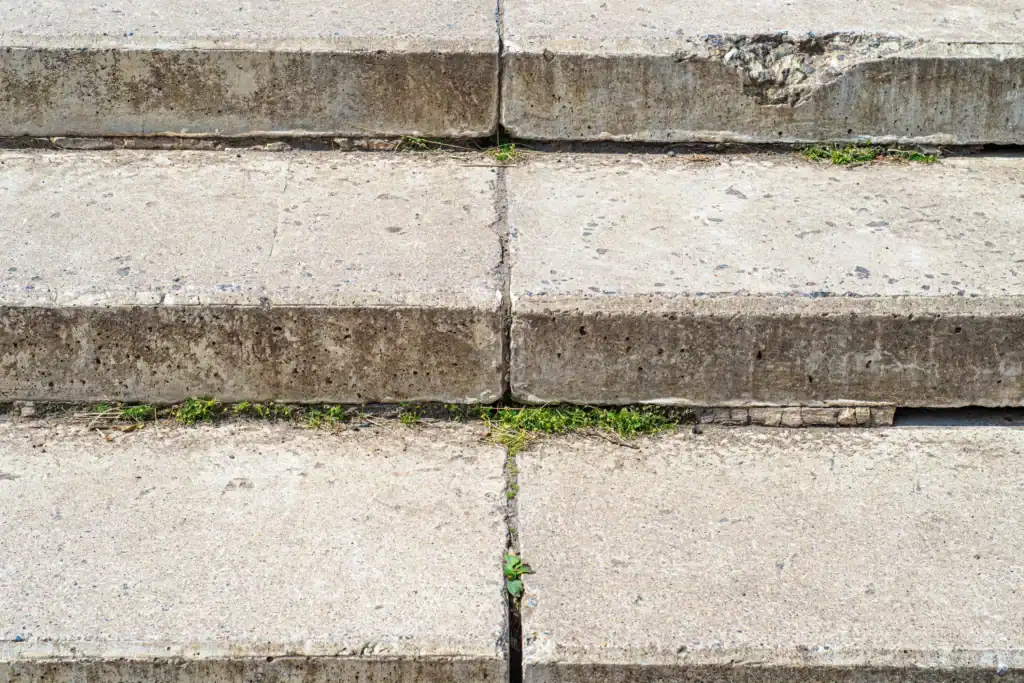
Full replacement is often needed when steps show structural cracking, severe settling, or reinforcement exposure. Surface patching does not address underlying instability. Long term safety depends on rebuilding the structural base. For site evaluation and replacement planning, a concrete project quote helps determine scope, design requirements, and code considerations.